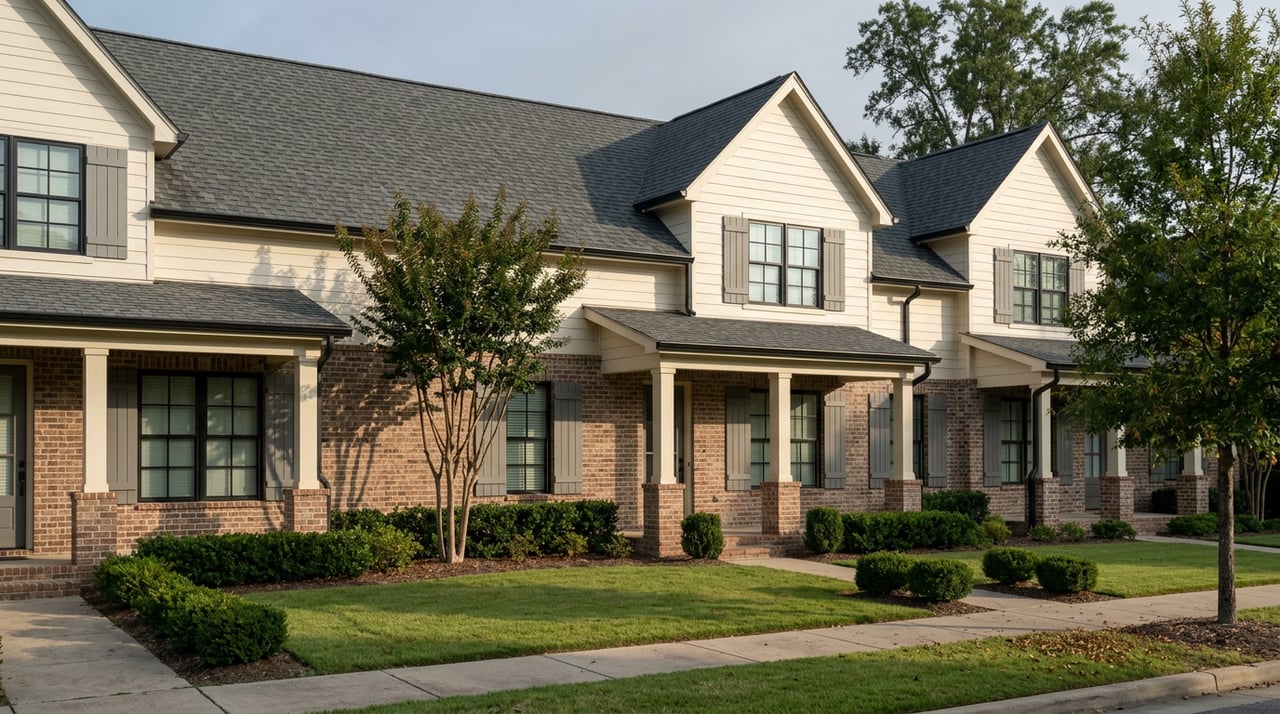
Walk down Toomer Street right now and you'll see cranes over a demolition site where Elm Court apartments used to stand. Landmark Properties is clearing the block for The Mark at Auburn, a 3.3-acre mixed-use student housing project with frontage on both Wright and Toomer streets. A few blocks over, The Rise at Auburn is moving through its own construction sequence. Both are large, both are new, and both are being built in a part of downtown where the city has technically frozen this exact kind of construction since November 2025.
That contradiction is the whole story. Auburn's building moratorium on multi-unit developments and private dormitories in the Urban Core and Urban Neighborhood-West districts is real, it's still active, and it expires November 30, 2026. But, as the Auburn Villager reports, the two biggest projects going up inside the frozen zone were approved before the freeze took effect, so they're grandfathered in and moving forward regardless. If you're comparing Auburn to other East Alabama options and you've heard the freeze is ending soon, the honest answer is more complicated than "supply opens back up in December."
A Freeze With Built-In Exceptions
The Auburn City Council approved the moratorium unanimously on November 18, 2025, blocking any new development with two or more unattached units, or three or more attached units, on a single lot within the Urban Core and Urban Neighborhood-West zones. The council originally considered an 18-month freeze but shortened it after pushback, landing on 12 months with an expiration of November 30, 2026.
City officials framed the pause around infrastructure, not opposition to growth. Water Resource Management Director Eric Carson told the council the sewer system was already showing bottlenecking after a decade of rapid development, and City Engineer Brandy Ezelle presented traffic data showing key intersections in the moratorium zone carrying heavier loads than at any point in the past five years. The two projects cited most often in that traffic presentation, The Mark at Auburn and The Rise at Auburn, are projected to add roughly 2,600 vehicle trips a day to those same streets once complete. Both are proceeding anyway.
The Opelika Observer quoted Mayor Ron Anders on the risk of letting the clock run out without a plan:
"I think it's really important that there's a lot of communication to the council, that we're well-aware of what's going on and that we don't reach that 11th month and be totally surprised."
We're in that 11th month now.
The Zone Is Smaller Than It Sounds
It's tempting to hear "downtown Auburn building freeze" and assume the whole near-campus market is locked down. It isn't. The ordinance targets two specific zoning districts, and Planning Director Justice Wahid Cotton told the council that the developers most affected are the ones building high-density student housing, the six-plus story projects that depend on the highest bed-per-acre allowances the city permits. Cotton also noted there's still buildable capacity in parts of Urban Neighborhood-West that haven't reached maximum density, meaning the freeze is really concentrated on the corridor where large-scale student housing already clusters, not on every parcel near campus.
That distinction matters if you're evaluating a condo, a small multifamily property, or a single-family home in Auburn. The moratorium doesn't touch single-family lots, and it doesn't reach neighborhoods outside the Urban Core and Urban Neighborhood-West boundaries at all. What it does affect is the pipeline of new large-scale student housing that would otherwise compete for the same renters and, in some cases, the same land.
Why November 30 Isn't the Clean Reset It Looks Like
Here's the part that changes how you should think about timing. The moratorium's legal expiration date is fixed, but the work it was supposed to produce is not on the same clock.
| Date | What happened |
|---|---|
| Nov. 18, 2025 | Council approves 12-month moratorium (Ordinance No. 3557) covering Urban Core and Urban Neighborhood-West |
| Dec. 2025 | Kimley-Horn contracted to lead the traffic study inside the moratorium footprint |
| Feb. 2026 | City signs preliminary agreement with zoning consultant Whitesmith and Cusano (WSC) |
| March 2026 | Stormwater consultant Neel-Schaffer holds kickoff meeting for drainage study |
| April 2026 | The Mark at Auburn breaks ground, unaffected by the freeze under its prior approval |
| May 5, 2026 | Council receives progress update; staff say final recommendations "may not be ready" by the Nov. 30 deadline |
| Sept. 15, 2026 | WSC begins work on a separate downtown lounge moratorium while the housing code rewrite continues; full rewrite still projected at more than 24 months |
| Nov. 30, 2026 | Moratorium's legal expiration |
At the May update, city staff told the council directly that they could neither guarantee nor rule out having formal recommendations ready by the November deadline. And as of the September 15 council meeting, the consulting firm handling the zoning rewrite confirmed the full process will take more than two years. So the moratorium can expire on schedule while the actual policy work that was supposed to replace it is still in progress.
Auburn has been here before. The city's own student housing timeline shows a pattern of extending these freezes rather than letting them lapse cleanly. A moratorium first approved in February 2015 was extended in 90-day increments, and a separate six-month freeze in the University Service District went through a third extension before the city settled on permanent zoning changes years later. History doesn't guarantee what the council does this time, but it does mean "the freeze lifts November 30" and "new supply resumes November 30" are not the same claim.
What This Means If You're Comparing Neighborhoods
For a buyer weighing Auburn against other East Alabama options, the near-campus rental and condo market you're looking at today is shaped less by raw demand than by a specific zoning decision that has an expiration date attached but no guaranteed outcome behind it. A few things worth separating out:
- The large student housing supply coming online in the next two years (The Mark at Auburn and The Rise at Auburn) was locked in before the freeze and will deliver regardless of what happens November 30.
- Any new large-scale project in the Urban Core or Urban Neighborhood-West still needs the moratorium to end and, more importantly, needs the zoning rewrite to reach a stage where new applications can actually be filed under updated rules.
- Smaller-scale near-campus properties, the kind more likely to interest a traditional buyer or a short-term-rental investor, were never subject to the freeze in the first place.
If you're evaluating a condo or small multifamily purchase near campus for income potential, the practical takeaway isn't that a wave of new competition is coming December 1. It's that the timeline for new large-scale supply is genuinely uncertain, which is useful information if you're trying to time an acquisition against future rental competition rather than against a headline deadline.
A Few Questions Worth Asking Before You Write an Offer
Does the moratorium apply to the property I'm looking at? Only if it sits within the Urban Core or Urban Neighborhood-West districts and the project involves two or more unattached units or three or more attached units on one lot. Single-family homes and most condos are unaffected.
If the freeze ends November 30, will new construction start right away? Not necessarily. City staff have said the studies behind the freeze may not produce final recommendations by that date, and the broader zoning code rewrite is expected to run past 2028.
Are The Mark at Auburn and The Rise at Auburn part of the frozen zone? Yes geographically, but both were approved before the ordinance took effect, so they're proceeding under their original agreements.
Zoning timelines like this one rarely show up in a portal search, but they shape what gets built, when, and where over the next several years. If you're trying to figure out what a specific Auburn address means for your plans, whether that's a move-up purchase, a first home near campus, or a short-term-rental acquisition, Carter Pair can walk through what's actually happening on a given block and what it's likely to mean by the time you close. Contact Carter to talk through your specific situation before you write an offer.
This article is general information, not legal, tax or financial advice. Consult a qualified professional about your situation.